1. What Is The Oil Tanker Trailer In Ghana
2. Common Specifications & Key Features For Ghana Road Conditions
3. What Types Of Tanker Trailers Are There?
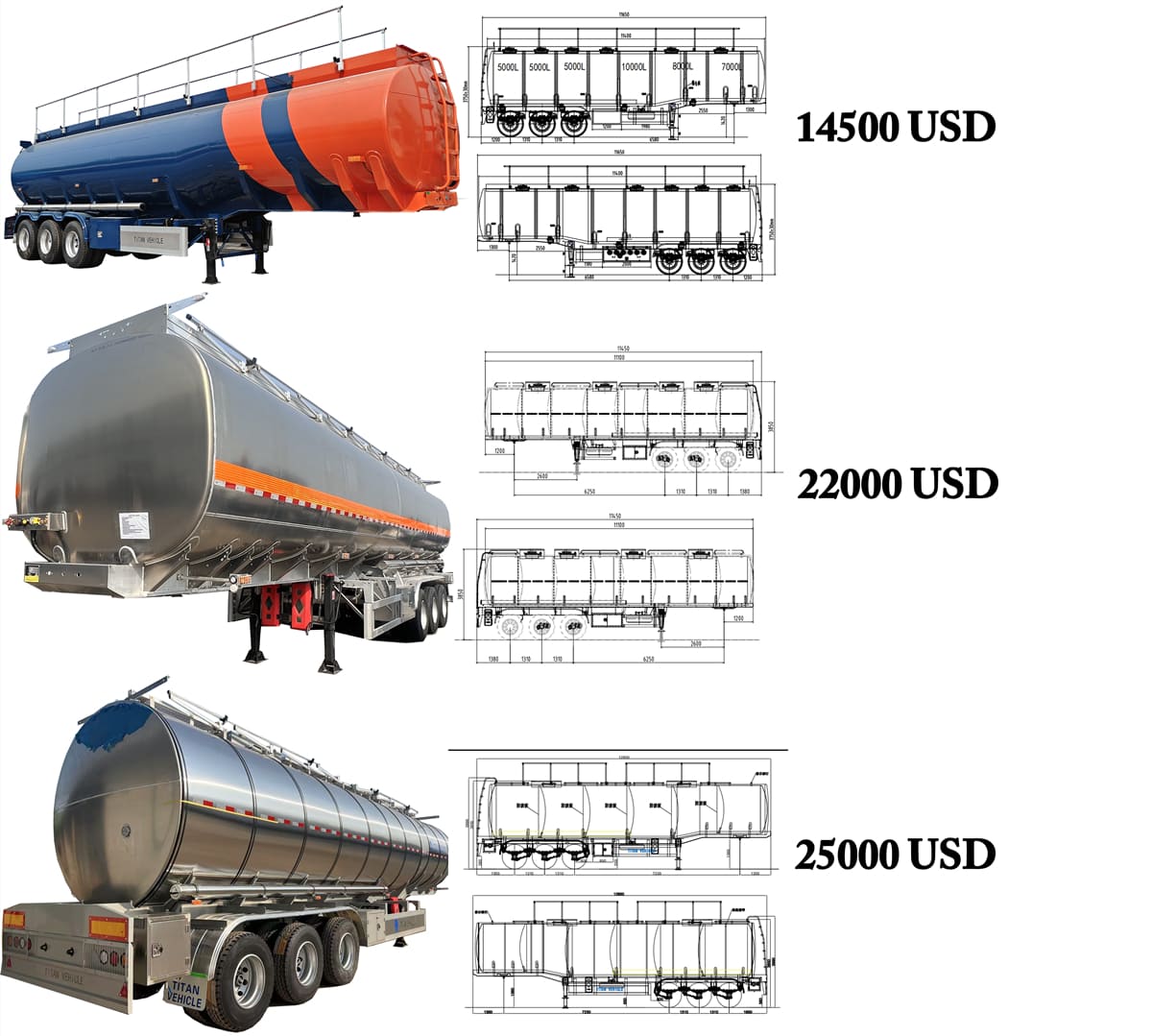
4. How Much Is An Oil Tanker Trailer?
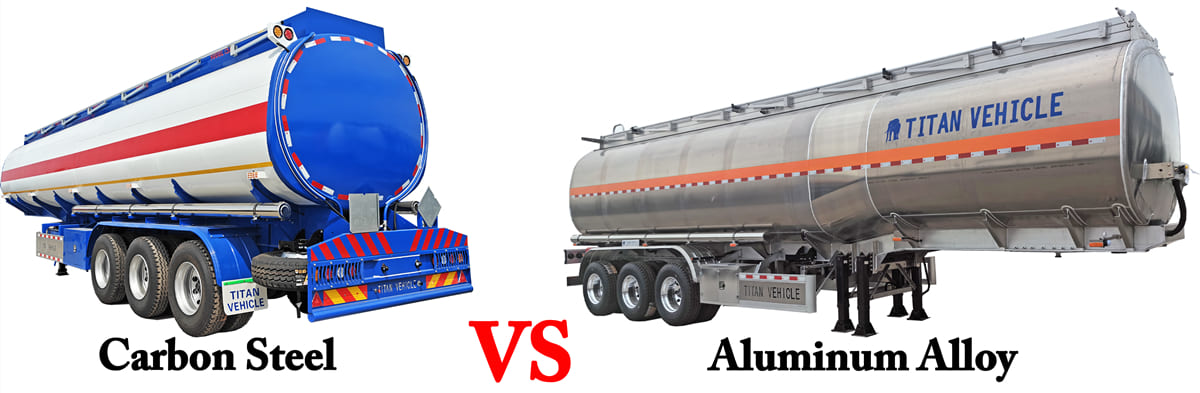
5. Carbon Steel Vs. Aluminum Alloy: Which Is Better For You
6. How To Choose A Reliable Chinese Manufacturer For Ghana Imports
Ghana has a growing demand for road tanker equipment because petroleum products must be transported efficiently between ports, fuel storage terminals, distribution centers, mining areas, industrial facilities, and filling stations. For companies looking for an oil tanker trailer for sale, the most important considerations are not simply the purchase price.
Tank material, capacity, axle configuration, suspension, braking system, pump and discharge equipment, road conditions, product compatibility, maintenance requirements, and manufacturer experience all influence the real operating value of an oil tanker trailer.
For Ghanaian buyers, an oil tanker semi trailer is commonly selected when the objective is to transport diesel, petrol, gasoline, kerosene, or other compatible liquid petroleum products using a tractor unit. The right tanker can provide a practical balance between payload, fuel consumption, road stability, safety, maintenance cost, and service life.
At the same time, the cheapest oil tanker price is not necessarily the lowest total cost because a poorly configured trailer can create higher maintenance, downtime, and operating expenses.
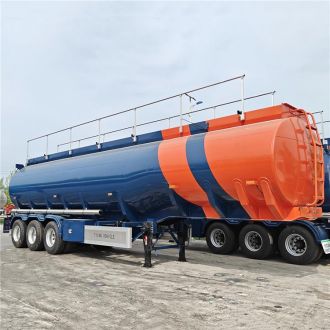
An oil tanker trailer in Ghana is a specialized road trailer designed to transport liquid petroleum products safely and efficiently, with the most suitable configuration depending on the transported product, required capacity, road conditions, tractor capacity, and local operating requirements.
An oil tanker trailer is a semi-trailer equipped with a cylindrical or elliptical tank body for transporting liquid cargo. Unlike a normal flatbed or cargo trailer, an oil tanker trailer is designed around the physical and safety characteristics of liquid products. Its tank must resist internal pressure, vibration, impact, corrosion, and repeated loading and unloading. The trailer also requires appropriate valves, manholes, discharge outlets, piping, emergency equipment, braking components, suspension, and lighting.
In Ghana, oil tanker trailers are widely relevant to petroleum distribution because imported fuel and petroleum products need to move from major storage and distribution points to fuel stations and commercial users. A typical transportation operation can involve a tractor pulling an oil tanker semi trailer over highways, urban roads, industrial access roads, and sometimes less-developed regional routes. This makes structural strength and road adaptability particularly important.
A tanker is normally divided into several compartments when different products or different grades of petroleum products need to be transported in the same trip. A multi-compartment design can also help distribute liquid cargo along the length of the trailer. The number and size of compartments should be determined according to the buyer's loading operation rather than simply choosing the largest possible tank.
For example, a Ghanaian petroleum distributor may need a 40,000-liter tanker for regional fuel distribution, while another operator may require a 45,000-liter or 50,000-liter configuration for longer-distance bulk transportation. A mining-related fuel distributor may prioritize heavy-duty suspension, reinforced chassis construction, and reliable discharge equipment because the tanker may operate on demanding access roads.
The key distinction between a tanker trailer and a tanker truck is the relationship between the tank and the vehicle. A tanker truck has the tank mounted directly on the truck chassis, while an oil tanker semi trailer is pulled by a separate tractor unit. This arrangement allows the operator to use one tractor with different trailers or replace the tractor independently from the tank trailer.
When comparing an oil tanker trailer for sale, buyers should therefore evaluate the entire vehicle rather than only the tank volume. Two tankers can have the same nominal capacity but very different operating performance because of differences in axle design, suspension, tank construction, piping, braking, welding quality, and component brands.
Another important consideration is the relationship between capacity and legal payload. A larger tank does not automatically mean that the trailer can legally carry more fuel. The density of the product, tank tare weight, tractor weight, axle loads, road restrictions, and applicable Ghanaian requirements all affect the practical payload. Therefore, a buyer should calculate the operating weight before selecting a high-capacity oil tanker semi trailer.
For Ghanaian operators, the ideal oil tanker trailer should also be easy to maintain. Components such as axles, brake chambers, suspension parts, valves, tires, lighting, and electrical connectors should be commercially available or reasonably easy to source. A tanker that performs well but requires difficult-to-source components may create unnecessary downtime.
 What Is The Oil Tanker Trailer In Ghana
For Ghana road conditions, the best oil tanker trailer combines a strong tank and chassis with suitable axle loading, dependable suspension, effective braking, corrosion protection, practical ground clearance, and easy-to-maintain components rather than simply maximizing tank capacity.
The operating environment should be one of the first factors considered when purchasing an oil tanker trailer for sale in Ghana. Ghana has major paved highways and developed urban routes, but tanker operators can also encounter rough regional roads, uneven surfaces, potholes, construction zones, industrial roads, and access roads around mines and fuel storage facilities.
Liquid cargo creates another challenge. When a tanker accelerates, brakes, turns, or travels over uneven terrain, the liquid inside the tank moves. This phenomenon, often called liquid surge, can influence vehicle stability. Proper internal compartment design and anti-surge structures can reduce the effect and make the tanker more predictable during transportation.
For this reason, the tank body should not be viewed as a simple container. Its internal configuration, shell thickness, baffles, compartment arrangement, welding, reinforcement, and mounting structure all contribute to operating safety.
 Common Specifications & Key Features For Ghana Road Conditions
Capacity is one of the first specifications customers search for when comparing an oil tanker trailer for sale. Common commercial configurations may include 30,000 liters, 35,000 liters, 40,000 liters, 45,000 liters, 50,000 liters and larger capacities.
However, capacity should be selected according to the actual transportation requirement. A 50,000-liter tanker is not necessarily better than a 40,000-liter tanker. If road restrictions, tractor power, axle limitations, loading infrastructure, or local operating conditions make the larger configuration impractical, the additional capacity can become an unnecessary cost.
For many petroleum distribution applications, 40,000–45,000 liters offers a useful balance between transportation volume and overall vehicle configuration. Larger tankers can be considered when the route, tractor, loading facility, and applicable regulations support them.
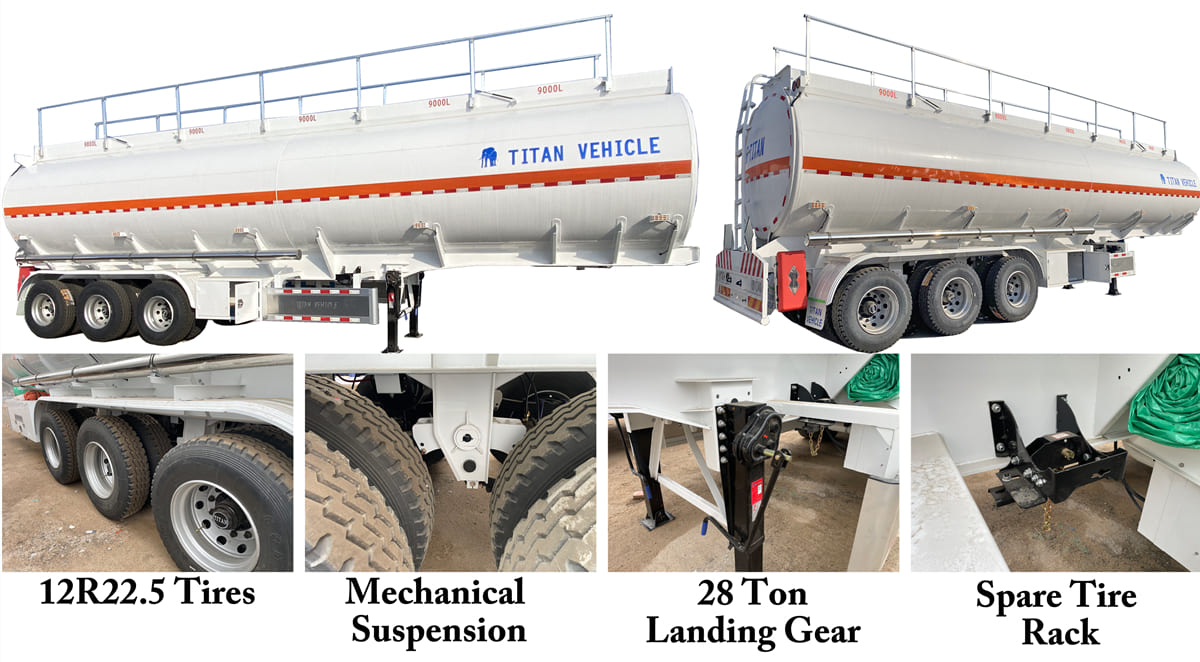
The chassis of an oil tanker semi trailer carries the tank, axles, suspension, kingpin, landing gear, braking components, and other equipment. It must withstand repeated dynamic loading rather than only the static weight of the fuel.
A quality manufacturer should design the chassis according to the intended load and operating environment. High-strength structural steel can provide the required strength while controlling tare weight. The tank should also be properly mounted so that loads are transferred through the structure without creating unnecessary stress concentrations.
Welding quality is especially important. Long-term tanker operation exposes welded areas to vibration and cyclic stress. Inadequate welding, poor joint preparation, inconsistent penetration, or insufficient inspection can create problems that may not appear during initial delivery but can become serious after repeated use.
Suspension is another major factor for Ghanaian roads. Mechanical leaf-spring suspension is widely used on heavy semi-trailers because it has a relatively simple structure and is easy to repair. It can be a practical option for operators who prioritize durability and straightforward maintenance.
Air suspension can provide improved ride characteristics and can help reduce vibration transmitted to the trailer and cargo. It may be more attractive for operators running extensively on paved highways or looking for improved ride control.
The correct choice depends on the customer's route, maintenance capabilities, tractor configuration, and budget. A properly designed mechanical suspension can be an excellent choice for demanding applications, while air suspension can provide advantages for certain long-distance operations.
A loaded oil tanker trailer has substantial momentum, making braking performance critical. Pneumatic braking is standard on many heavy commercial trailer configurations. ABS can help maintain wheel control during emergency braking, while EBS can provide more advanced electronic brake management on compatible vehicle systems.
The braking system should be correctly matched to the axle configuration, tire size, trailer weight, and tractor system. Buyers should also consider the availability of replacement brake components in Ghana.
Internal baffles are important in many tanker applications because they help control liquid movement. A tanker carrying a partially filled load can experience significant liquid movement during acceleration and braking. Proper compartment and baffle design can reduce the effect and contribute to more stable handling.
For multi-product distribution, compartments can allow different fuels to be transported simultaneously. For example, a tanker can be configured with several compartments for different delivery destinations or products.
The compartment layout should be determined before manufacturing because changing it later can be difficult and expensive.
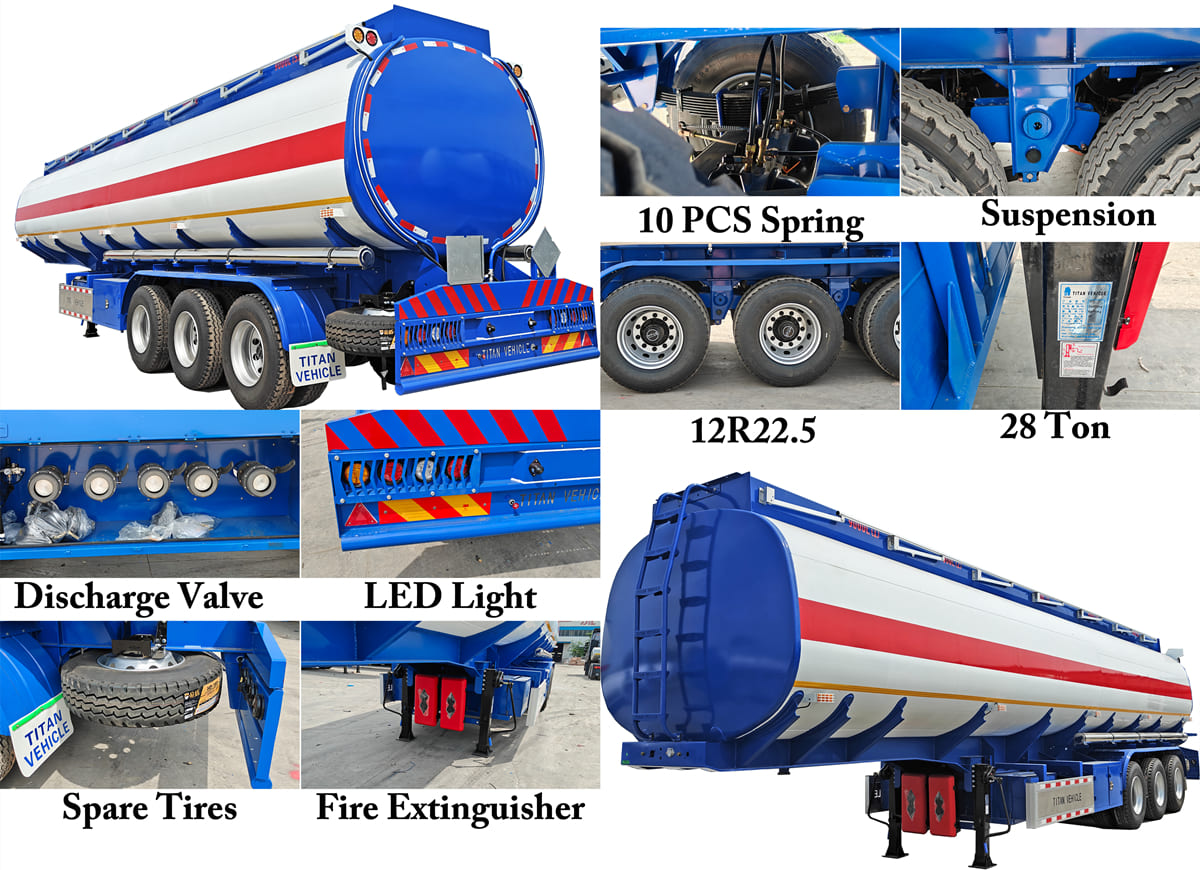
The discharge system should match the customer's loading and unloading process. Some operations use gravity discharge, while others require pumps or specific flow-control equipment.
A typical tanker can include bottom valves, discharge piping, API-style fittings where appropriate, manholes, vents, emergency shutoff components, and other equipment specified for the application. The exact equipment should be selected according to the petroleum product, loading terminal, receiving station, and local safety requirements.
The main types of oil tanker trailer differ by tank material, capacity, compartment layout, axle configuration, and transported product, so Ghanaian buyers should choose the tanker type based on the actual fuel distribution operation instead of using capacity alone as the selection criterion.
There is no single tanker design that is suitable for every petroleum transportation business. When searching for an oil tanker trailer for sale, buyers will usually encounter different configurations designed around payload, material, product, road conditions, and loading requirements.
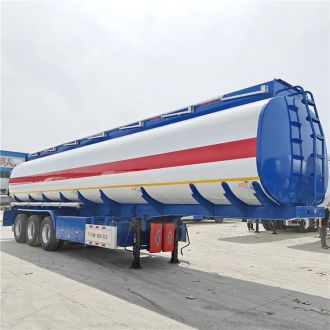
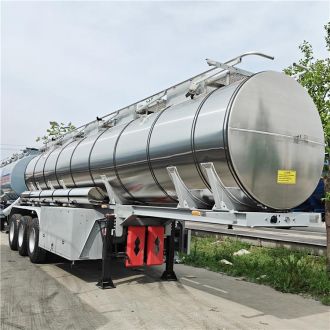
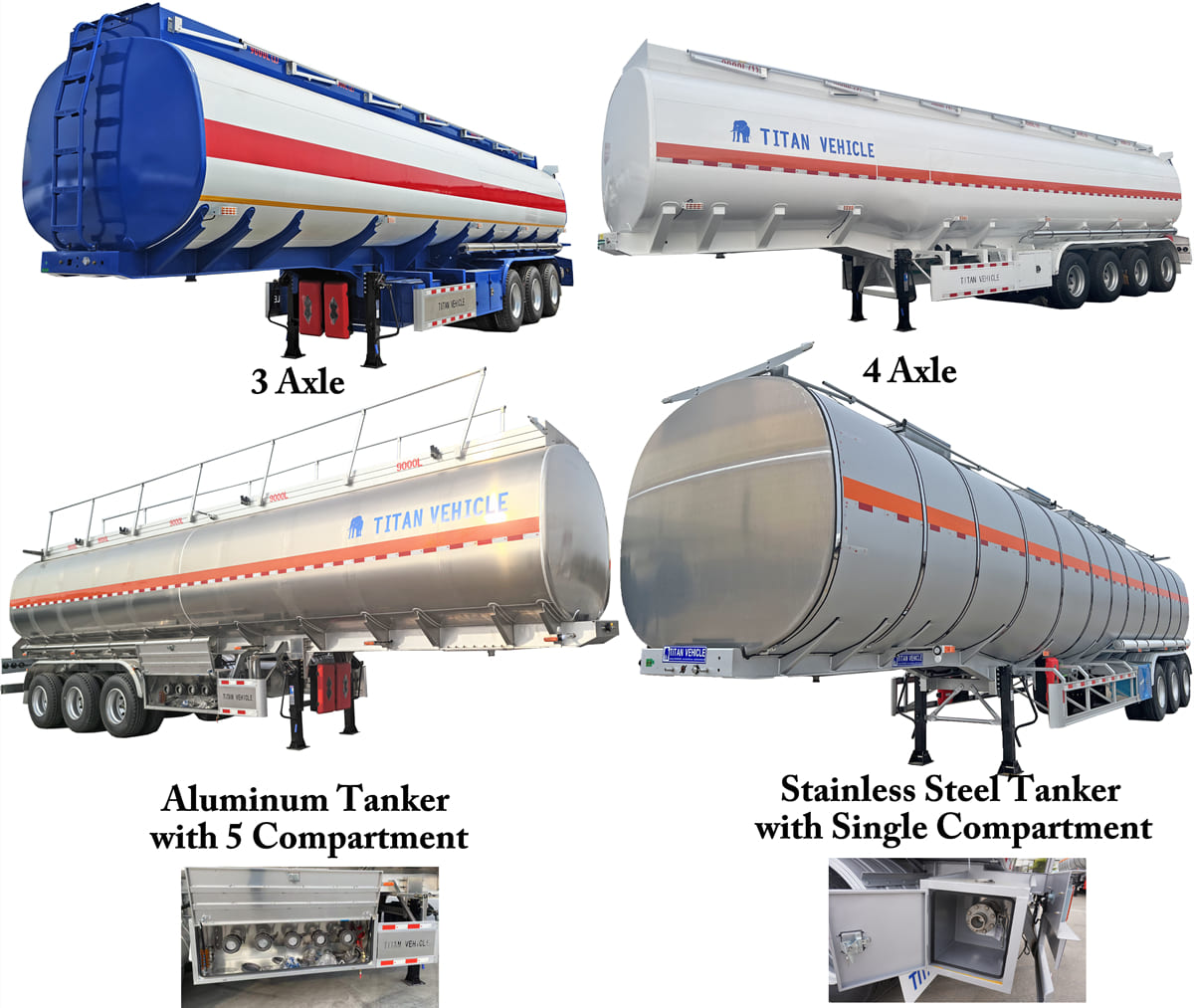
The first major classification is by tank material. Carbon steel tankers are widely selected for their strength and relatively economical purchase cost. Aluminum alloy tankers are lighter and can offer a useful payload advantage, particularly where weight efficiency is important.
The second classification is by compartment. A single-compartment tanker is relatively straightforward and can be suitable when one product is carried. Multi-compartment tankers are more flexible for fuel distributors because they can carry different products or grades in separate chambers.
A single-compartment tanker is often simpler to manufacture, operate and maintain. It can be suitable when the transportation business primarily handles one fuel product or when the delivery system does not require multiple grades.
The simplified design can also make cleaning and inspection more straightforward. However, the operator cannot transport multiple products independently without using separate trailers or cleaning the tank between different products.
For fuel distributors, a multi-compartment oil tanker semi trailer can provide greater logistical flexibility. Different compartments can be assigned to different products or customers, allowing one trip to serve multiple delivery requirements.
For example, a distributor could use separate compartments for petrol and diesel, subject to product compatibility and operational requirements. Another operator could divide the tank into different capacities based on customer demand.
Compartment configuration is therefore an important commercial decision. Instead of asking only "How many liters can the tanker carry?", buyers should ask how the tanker will be loaded, transported and unloaded every day.
Carbon steel is a traditional choice for many petroleum tankers because it provides strong structural performance and is generally more economical than aluminum alloy. A properly manufactured carbon steel oil tanker trailer can provide a long operating life when it receives appropriate surface protection and maintenance.
The main disadvantage is weight. Carbon steel is heavier than aluminum alloy, which means part of the vehicle's allowable weight is used by the trailer itself rather than cargo.
For operators who prioritize purchase economy, structural durability and easy fabrication, carbon steel can remain an attractive choice.
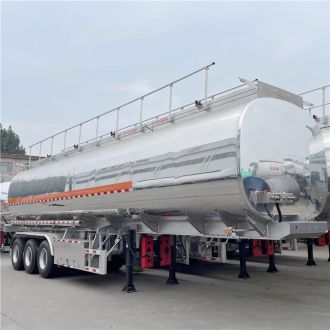
Aluminum alloy tanker bodies can significantly reduce tare weight compared with conventional carbon steel designs. This can create additional payload potential within applicable weight limits.
The higher initial investment can be justified when the tanker operates frequently and payload efficiency has a meaningful impact on transportation revenue. Aluminum is also naturally resistant to certain forms of corrosion, although the complete tanker still contains steel components and requires proper maintenance.
The choice between aluminum and carbon steel should therefore be based on total operating economics rather than material price alone.
Ghana's mining industry creates additional demand for fuel transportation. Mining sites may be located away from major urban centers, requiring tankers to travel longer distances and sometimes operate on rough access roads.
A heavy-duty oil tanker trailer for such applications may use reinforced structural components, robust suspension, durable tires, reliable braking systems and protective equipment appropriate for the operating environment.
The goal is not simply to make the tanker heavier. Excessive weight reduces payload efficiency. Instead, the manufacturer should reinforce the components that experience the greatest operational stresses.
 What Types Of Tanker Trailers Are There?
The oil tanker price in Ghana depends mainly on capacity, tank material, axle configuration, compartment number, discharge equipment, component brands, manufacturing standards, shipping terms, and customization, so a realistic quotation should be based on a complete specification rather than a generic online price.
The oil tanker price is one of the first questions asked by buyers looking for an oil tanker trailer for sale. However, there is no single universal price because tanker trailers are customized commercial vehicles.
A basic carbon steel tanker with a straightforward configuration will normally cost less than a high-capacity aluminum tanker with multiple compartments, advanced braking, premium axles, pump systems, special valves and customized safety equipment.
For buyers importing from China to Ghana, the final landed cost may include the factory price, inland transportation in China, port charges, ocean freight, insurance where applicable, customs-related costs, local transportation, and other import expenses. Therefore, the factory quotation and the final Ghana cost are not necessarily the same.
For example, two companies may both request a 45,000-liter oil tanker trailer for sale, but their quotations can be significantly different. One may request a carbon steel tank, three axles, mechanical suspension and standard valves. Another may require aluminum alloy, five compartments, air suspension, advanced braking and an integrated pump.
The second tanker will naturally have a higher oil tanker price, but the additional investment may provide greater payload efficiency and operational flexibility.
The factory cost covers the trailer itself and selected specifications. Logistics costs include transportation to the port, ocean freight and related charges. Operating costs include tires, maintenance, brakes, suspension parts, inspections and other expenses during the tanker's service life.
This approach gives a much better understanding of the actual economics of an oil tanker semi trailer.
A buyer should also ask whether the quoted price includes the complete specification. Some low advertised prices may represent a basic configuration and exclude optional equipment that the buyer later discovers is necessary.
The lowest oil tanker price can be attractive, but a tanker is a long-term commercial asset. Saving money at purchase can become expensive if the trailer has weak suspension, poor-quality valves, low-grade tires, insufficient corrosion protection or difficult-to-source components.
For Ghanaian operations, after-sales support should be considered alongside the initial price. A manufacturer that can provide spare parts, technical drawings, component information and remote technical assistance can reduce downtime.
The better purchasing question is therefore not "What is the cheapest oil tanker price?" but "What is the best total cost of ownership for my route and cargo?"
 How Much Is An Oil Tanker Trailer?
Carbon steel is generally the better choice when purchase economy, strength, easy fabrication and straightforward maintenance are the priorities, while aluminum alloy is usually better when low tare weight and maximum payload efficiency are more important.
Material selection has a direct influence on the oil tanker price, payload potential, durability, maintenance requirements and long-term operating economics.
Carbon steel has traditionally been widely used for tanker construction because it offers high structural strength and relatively straightforward manufacturing. It is also familiar to many heavy-equipment manufacturers and repair workshops.
Aluminum alloy has a much lower density than steel. This allows manufacturers to reduce the tanker's tare weight while maintaining the required structural design. For an operator that moves large volumes over long distances, the payload advantage can potentially generate meaningful commercial value.
A carbon steel oil tanker trailer is often a practical choice for operators who prioritize a lower purchase investment and robust construction.
For demanding roads, a well-engineered carbon steel structure can provide excellent durability. It is also relatively familiar to local repair technicians, which can be valuable when operating away from major cities.
Carbon steel is particularly attractive when the operator's primary concern is initial investment rather than maximizing every kilogram of payload.
However, carbon steel requires proper surface protection. The external environment in Ghana can include humidity, rain and coastal exposure, so an appropriate primer and topcoat system should be used. Damaged coatings should be repaired promptly to prevent corrosion from progressing.
An aluminum alloy oil tanker trailer can be more attractive for operators who regularly transport high-volume petroleum products and want to reduce trailer tare weight.
The main advantage is payload efficiency. If the legal gross vehicle weight and axle loads allow additional cargo, a lighter trailer can potentially transport more product within the permitted operating weight.
This can be particularly valuable on long-distance routes where each trip represents a significant transportation cost.
However, aluminum tankers generally require a higher initial investment and more specialized repair expertise. Therefore, the business case should be evaluated based on annual mileage, number of trips, payload value and expected service life.
For many Ghanaian buyers purchasing their first tanker, carbon steel can provide a practical balance between price and durability. For established transport companies with high annual utilization, aluminum alloy may provide better long-term economics if payload efficiency is commercially important.
There is no universal answer. The correct material depends on the business model.
A buyer transporting moderate volumes over shorter distances may benefit more from a lower oil tanker price. A high-utilization operator running long-distance routes may recover the higher aluminum investment through additional payload capacity over time.
 Carbon Steel Vs. Aluminum Alloy: Which Is Better For You
A reliable Chinese manufacturer should be evaluated through engineering capability, production quality, certifications and documentation, component selection, Ghana-relevant experience, customization ability, spare-parts support, inspection procedures, and transparent communication—not simply through the lowest oil tanker price.
China is one of the world's major manufacturing bases for semi-trailers and heavy transportation equipment. Ghanaian buyers can find a wide range of suppliers offering an oil tanker trailer for sale, but the quality and manufacturing capabilities of suppliers can vary significantly.
The first step is to determine whether the manufacturer is actually a factory or primarily a trading company. A trading company may still provide a satisfactory product, but buyers should understand who is responsible for engineering, manufacturing, quality control and after-sales support.
A direct manufacturer can generally provide more detailed technical information about the tank structure, chassis design, welding process, component selection and customization.
A serious manufacturer should be able to provide a detailed technical specification rather than simply saying "40,000-liter tanker" or "45,000-liter tanker."
The quotation should clearly identify capacity, number of compartments, tank material, tank dimensions, axle brand, axle capacity, suspension, tires, brake system, kingpin, landing gear, valves, discharge system, lighting, surface treatment and optional equipment.
This is particularly important when comparing oil tanker price between Chinese suppliers. If two quotations do not contain the same specifications, their prices cannot be compared fairly.
Before purchasing an oil tanker semi trailer, ask the manufacturer for a general arrangement drawing.
The drawing should show the overall length, width, height, axle position, kingpin location, tank capacity, compartment arrangement, discharge position and major dimensions.
This helps prevent misunderstandings between the buyer, tractor supplier, transport operator and manufacturer.
It also allows the buyer to confirm that the tanker will match the intended tractor and loading/unloading facilities.
A reliable manufacturer should clearly identify the material used for the tank body and structural components. For carbon steel tanks, the buyer should understand the steel grade and surface protection system. For aluminum alloy tanks, the manufacturer should identify the alloy and explain the welding and repair requirements.
The manufacturer should also be able to explain the internal structure and compartment design.
A high-quality oil tanker trailer should have a consistent manufacturing process. Tank welding, structural joints and mounting points deserve particular attention because they experience repeated mechanical loads during transportation.
Component selection is another important indicator of manufacturer quality.
Ask for the axle brand, suspension components, brake system, tires, landing gear, kingpin, valves, piping and electrical components. Well-known components can make future maintenance easier, but they are not automatically necessary for every application.
The important point is consistency between the component specification and the intended operating conditions.
A tanker designed for Ghana should prioritize components that can be maintained and replaced without excessive difficulty.
Before shipment, buyers can arrange or request a pre-delivery inspection. The inspection can verify dimensions, welding appearance, tank configuration, compartment layout, tires, axles, suspension, braking components, valves, paint quality and identification plates.
Photographs and videos can also be requested during production.
For a first order, inspection is especially useful because it creates an additional quality-control stage before the oil tanker trailer for sale leaves China.
The purchase relationship should not end when the trailer reaches Ghana.
Ask the manufacturer for a recommended spare-parts list. This can include brake components, suspension parts, valves, seals, lighting components, electrical connectors and other wear items.
A manufacturer that understands export customers should also be able to provide technical manuals and basic maintenance information.
For a fleet operator, spare-parts support can be more valuable than a small difference in the initial oil tanker price.
The logistics process should be considered when purchasing an oil tanker semi trailer from China.
The manufacturer normally prepares the trailer for export, transports it to the designated port, completes export documentation and coordinates with the shipping company according to the agreed Incoterm.
The buyer should confirm the shipping term, port of loading, destination port, freight responsibility, insurance arrangement, documentation, estimated production time and expected shipping schedule.
Because international freight rates change, the shipping portion should be confirmed at the time of purchase rather than assumed from an old quotation.
Suppose three manufacturers quote different prices for a 45,000-liter oil tanker trailer for sale. Supplier A offers the lowest price, Supplier B offers a medium price, and Supplier C offers the highest price.
The correct approach is not to choose Supplier A immediately.
Instead, compare the tank material, thickness, compartment arrangement, axle brand, suspension, brake system, tires, valves, pump, paint system, documentation, warranty, spare parts and inspection procedures.
If Supplier A excludes equipment that Supplier C includes as standard, the difference in oil tanker price may be much smaller than it initially appears.
Add: Nii Nortei Nyanchi St, Accra, Ghana
Marketing Manager: Hitomi Zhang
Mobile: 8615853176773